
How to Switch a Dog to a BARF Diet
The Right Diet for Your Dog
B.A.R.F. – Biologically Appropriate Raw Feeding
A dog’s health and lifespan are closely linked to its diet.

Feeding our dogs raw meat didn’t need to be reinvented.
Before the advent of industrially produced commercial dog food, there was nothing else.
Back then, dogs were fed scraps that humans discarded, or they hunted their own prey in the wild.
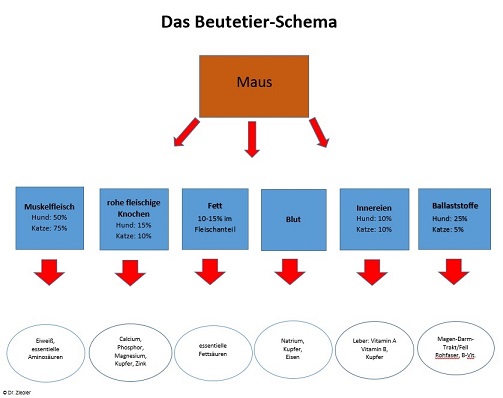
BARF simply means that dog food is made by mixing together fresh, raw ingredients. The goal is to replicate the prey that dogs and wolves hunt and eat in the wild.
BARF does NOT mean,
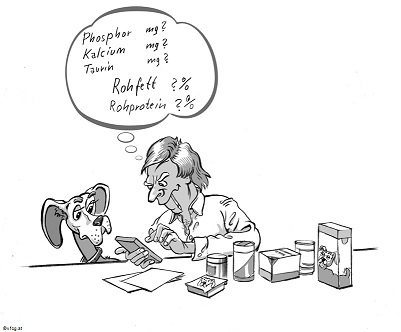
as many pet owners practice it, calculating every meal down to the gram each day to ensure that all nutrients are present in the “correct” proportions.
Many BARFers fall into the trap of copying the approach used by pet food manufacturers
and believing they must calculate and assemble the appropriate ration based on predetermined nutritional requirements. Unfortunately, these nutritional requirement figures are incorrect for various reasons. First, these figures are based on the feeding of animals that are fed industrially processed commercial pet food with a high grain content. However, the phytic acid contained in grains is a “nutrient thief,” meaning it inhibits and blocks the absorption of minerals in the intestine.
These minerals are subsequently added in inorganic form. However, their bioavailability is far inferior to that of the organic form. Second, the figures are still partly based on feed for fattening animals, and third, the animals’ individual digestive capacity is not taken into account. Calculations based on incorrect figures cannot yield a correct result.
BARF means:
We don’t need to do complicated calculations; instead, rations are put together using simple percentages, tablespoons, or teaspoons based on the prey-based diet model.
With BARF, there are only a few basic rules to follow, which are easy to learn, because BARF is not a science and is not difficult to implement.
Even sick animals can—and should—be fed a BARF diet.
Making the switch is the first step toward improved and more stable health, especially for sick animals.
How do you switch a dog to BARF?
As a rule of thumb, the feeding amount (daily ration) is:
5–7% of body weight for puppies
4% of body weight for young and adult dogs
2–3% of body weight for adult dogs
2% of body weight for senior dogs
A daily ration is composed as follows:
70 – 80% meat, divided as follows:
70% meat and fat
or
50% meat/fat and 20% green tripe
10–15% organ meats
15% meaty bones or cartilage
20–30% vegetables and fruit
carrots, zucchini, pumpkin, parsnips, lettuce, cucumbers, beets, boiled potatoes,
celery, black salsify, sprouts,
local fruits and berries, seasonal, not daily
Oils for omega-3 fatty acids
Switching from dry/wet food to BARF:
To allow your dog’s digestive tract to gradually adjust to raw meat, start by feeding only easily digestible lean meat mixed with cooked and pureed carrots. If your dog refuses to eat the raw meat at first, you can also briefly sear or blanch the meat. Over time, reduce the amount of searing or blanching until the meat is eventually fed raw.
Example of a transition:
Dog weight 25 kg with 3% = daily food amount 750 g, divided into:
30% vegetables = 230 g (225 g)
70% meat = 520 g (525 g)
or
50% muscle meat = 260 g
+ 20% tripe = 100 g (104 g)
15% offal = 78 g = 80 g
15% bones = 78g = 80g
For the first week:
Breakdown: 70% meat = 520g and 30% vegetables = 230g
e.g., 520g ground chicken or ground beef
and
230g cooked and pureed carrots
⇒ Stools become smaller and may be slightly slimy
For the 2nd week:
Add 1 tbsp salmon oil (omega-3 fatty acids) to the diet for 2–3 days
After 2–3 days, supplement with 440 g lean meat and 80 g liver (15% organ meat)
⇒ Please continue feeding this
For Week 3:
Add carrots and zucchini to the vegetable portion
After 2–3 days, supplement with 340 g of lean meat and 80 g of liver (15% organ meat) and 100g of green tripe.
If you do not wish to feed tripe, please proceed directly to Week 4.
⇒ Please continue feeding this diet
For Week 4:
After 2–3 days, supplement with 360 g of lean meat, 80 g of liver (15% organ meat), and 80 g of raw meaty bones (RFK) from ground chicken necks.
With tripe feeding: 260 g muscle meat + 100 g tripe + 80 g liver + 80 g raw meaty bones
Starting in the 5th week, the individual food components can be swapped out,
e.g., beef for chicken, liver for heart, or simply choose a BARF menu.
Supplements:
Lean meat (e.g., turkey, chicken, game) contains a maximum of only 5–10% fat, so please supplement with fat: 5–10 g of fat per 100 g of lean meat (e.g., lamb fat, beef fat, cold-pressed coconut oil), which means 90–95 g of meat + 5–10 g of fat = 100 g
If you do not plan to feed fresh bones, then calcium
Substitute:
1 tsp deer antler meal or
1/2 tsp seaweed lime per 10 kg of body weight or
½ espresso spoon eggshell powder per 10 kg of body weight
Please halve the amount of RFK (raw meaty bones) and add it to the lean meat:
360 g muscle meat plus 40 g (80:2) = 400 g muscle meat
If you have any questions about switching to BARF or about BARF feeding, we’re happy to assist you at any time by phone at +43 6245 71851 or by email at
info@dr-ziegler.eu.
Have you just adopted a puppy or are you planning to welcome a young dog into your home in the near future and want to get everything right from the start when it comes to nutrition? Then be sure to check out our blog post on the topic of "BARF for Puppies – Why It’s the Most Sensible Diet"!

